
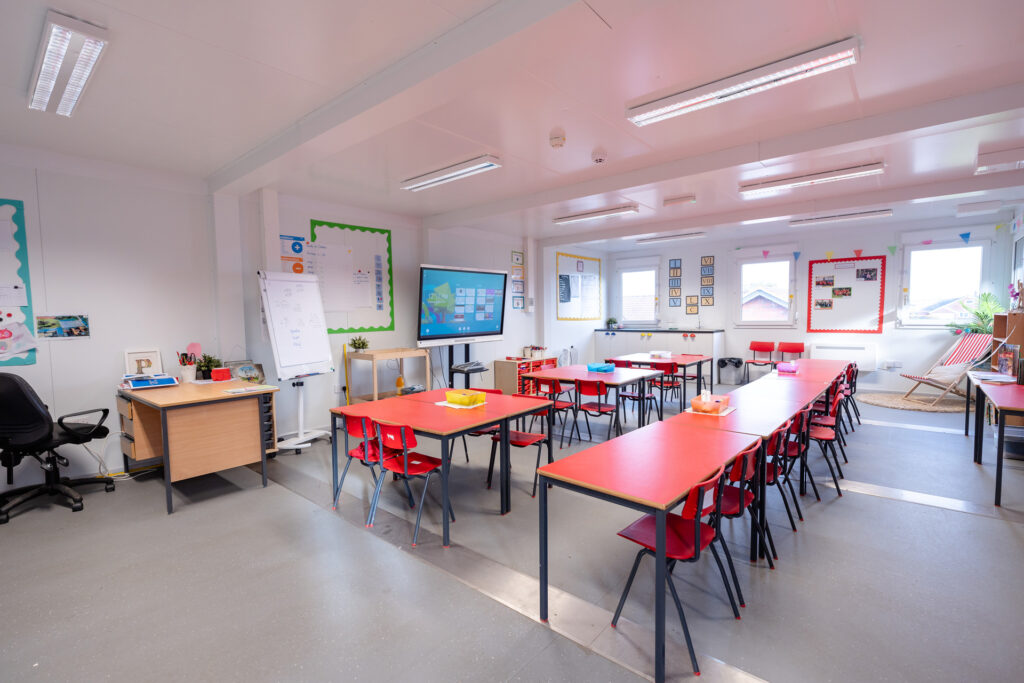
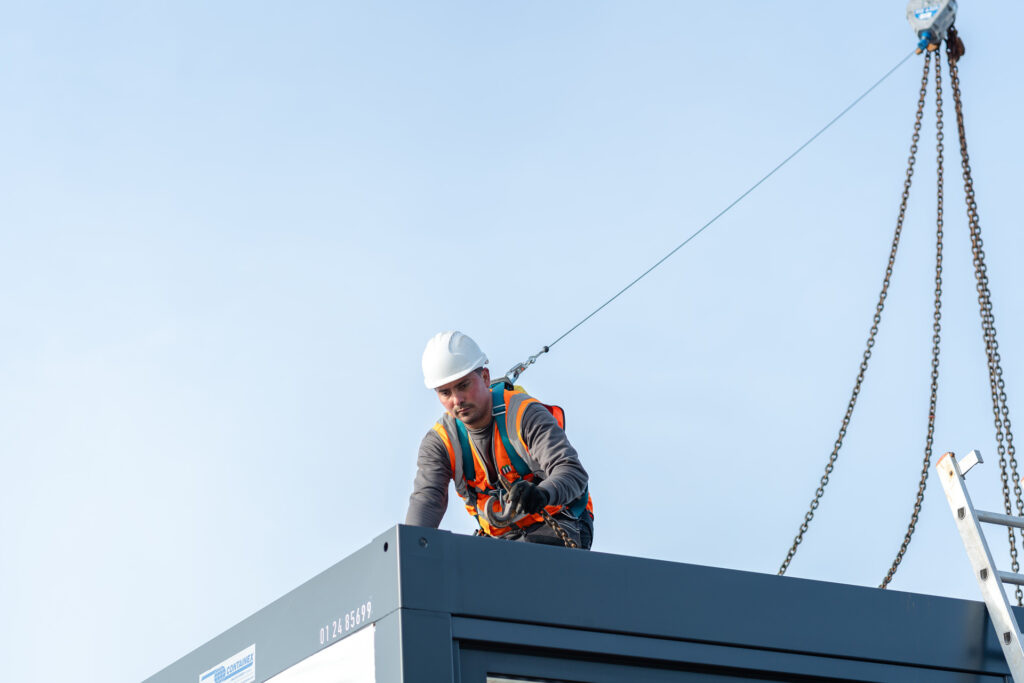
When The Billericay School faced an urgent crisis in 2024—structural issues with Reinforced Autoclaved Aerated Concrete (RAAC) forcing the immediate closure of parts of their main building—they needed a solution that could restore learning spaces within weeks, not months. Within four weeks of first contact, Maxi Space delivered eight fully equipped classrooms, enabling students to return to on-site education without compromising on quality or comfort.
This real-world example demonstrates why modular buildings have become the go-to solution for educational institutions across the UK facing space challenges, whether from emergency situations, planned expansions, or changing demographic needs.
The Growing Challenge in UK Education
UK schools are facing unprecedented pressure on their physical infrastructure. The Department for Education’s 2024 estates data shows that over 700,000 additional pupil places will be needed by 2026, whilst simultaneously, approximately 156 schools have been identified with critical RAAC issues requiring immediate remediation.
Traditional construction methods simply cannot respond at the pace required. The average permanent classroom extension takes 18-24 months from planning to completion, creating extended periods of disruption and often forcing schools to operate with compromised learning environments.
What Makes Modular Construction Different?
Modular buildings are prefabricated sectional structures manufactured in controlled factory environments, then transported to site and assembled rapidly. This methodology, known as Design for Manufacture and Assembly (DfMA), fundamentally changes the timeline and quality equation for temporary classroom provision.
Speed of Deployment
The contrast with traditional construction is stark. Where conventional building methods require sequential steps—foundation work, structural build, roofing, then internal fit-out—modular construction allows parallel workflows. Whilst site preparation occurs, classroom modules are simultaneously being manufactured offsite to exact specifications.
This approach delivered results for Billericay School that would have been impossible through traditional methods. The school received 640 square feet per classroom across eight units, each comprising four modules, fully fitted with heating, lighting, and modern finishes—all within a four-week delivery window.
For emergency situations like RAAC-related closures, this speed isn’t merely convenient; it’s essential to maintaining educational continuity and safeguarding student welfare.
Quality Control and Environmental Performance
Factory-based construction provides quality advantages that are particularly relevant for educational environments. Each module is constructed in controlled conditions, eliminating weather-related delays and ensuring consistent standards.
Modern modular classrooms achieve thermal performance that often exceeds traditional builds. Premier specification modules offer U-values as low as 0.23 for roofs and 0.57 for walls—significantly better than many existing school buildings. This translates directly into reduced energy costs and improved comfort for students and staff.
The internal ceiling height of 2.54 metres in PremierBuild modules maximises natural light distribution and creates the spacious, comfortable learning environments that educational research demonstrates are crucial for student wellbeing and academic performance.
The Full Lifecycle Advantage
Describing modular classrooms as merely “temporary” undersells their versatility and longevity. These structures are designed for 20+ year lifespans, offering schools genuine flexibility across multiple scenarios—whether for short-term or long-term use.
Adaptability to Changing Needs
Schools’ space requirements fluctuate. A primary school experiencing a demographic bulge might need additional Year 3 and 4 classrooms for five years, after which those cohorts progress and space needs shift. Modular buildings accommodate this reality in ways permanent structures cannot.
Units can be:
- Reconfigured internally as teaching needs evolve
- Relocated to different areas of the school site
- Expanded with additional modules
- Repurposed for different functions (classrooms to offices, or vice versa)
- Moved to entirely different schools within a trust or authority
This adaptability proves particularly valuable for multi-academy trusts managing property portfolios across multiple sites, allowing capital investment in buildings to flex with changing demographic patterns. Schools like Fordley Primary School and Nursery and Churchill Community College have successfully implemented modular solutions that grow with their needs.
Financial Flexibility
The economic model for modular classrooms offers options unavailable with traditional construction. Schools can choose to:
Purchase outright – Building the asset onto the balance sheet, with options for deferred payment terms that align with budget cycles.
Hire short-term – Renting modules for defined periods (typically 1-5 years), with all-inclusive terms covering delivery, installation, and removal.
Hire-to-own – Rental agreements that transition to ownership, converting operating expenditure to capital investment over time.
This flexibility proves especially valuable when funding is confirmed but timing is uncertain—a common scenario with Department for Education capital grants or Local Authority allocations.
Addressing Common Concerns
“Will They Look Like Portakabins?”
Modern modular classrooms bear little resemblance to the basic temporary structures of previous decades. External finishes can be specified to complement existing architecture, with options including:
- Timber cladding
- Rendered finishes
- Brick-effect panels
- Glazed sections for natural light
The Billericay School installation demonstrates this evolution—the buildings feature modern external aesthetics that integrate seamlessly with the school environment whilst providing internal spaces that students and staff describe as superior to many existing classrooms.
Similarly, Hazlewood Primary School showcases how modular buildings can enhance rather than detract from school environments.
“What About Planning Permission?”
Planning requirements for temporary school buildings are often more straightforward than assumed. Many modular classroom installations fall within permitted development rights, particularly when:
- Located within school grounds
- Below specific height thresholds
- Temporary in nature (though definitions of “temporary” can extend to several years)
However, each Local Planning Authority has specific requirements, and early engagement is advisable. Experienced modular building providers navigate these processes regularly and can guide schools through the necessary steps, often managing the entire planning application process.
“How Do They Perform in Real Teaching Environments?”
The evidence from operational installations addresses this question definitively. Students and staff at Billericay School described their new modular classrooms as “nicer than many of the old classrooms”—praising the modern finishes, excellent lighting, and comfortable environment.
This isn’t an isolated experience. Modular classrooms can be specified with:
- Acoustic insulation meeting BB93 standards
- HVAC systems providing optimal air quality and temperature control
- LED lighting designed for educational environments
- High-quality floor finishes (carpet tiles or vinyl)
- Full IT infrastructure including WiFi coverage and interactive display integration
The Sustainability Imperative
Educational institutions increasingly face pressure to demonstrate environmental responsibility. Modular construction aligns with sustainability objectives in several ways:
Reduced Site Impact
Traditional construction generates significant site disruption—noise, dust, vehicle movements, and waste. For operational schools, this affects learning conditions for months.
Modular installation typically completes in days rather than months. The Billericay project saw all units delivered and positioned in a single day, with installation completed within two working days. This minimal disruption maintains normal school operations whilst expansion occurs.
Energy Efficiency
Enhanced insulation specifications mean modern modular classrooms often outperform existing school buildings on energy consumption. Schools report heating and cooling cost reductions of 30-40% compared to older permanent structures.
This has budgetary benefits, but also supports schools’ carbon reduction commitments—an increasingly important factor for governing bodies and in Ofsted inspections.
Waste Reduction
Factory-based construction dramatically reduces construction waste. Precision manufacturing means materials are cut to exact specifications, with offcuts and waste materials managed through controlled recycling programmes rather than being transported to landfill from construction sites.
Making the Decision: Key Considerations
Schools considering modular classroom solutions should evaluate several factors:
Timeline Requirements
If students need classroom space within an academic year, modular construction is often the only viable option. A typical project timeline looks like:
- Weeks 1-2: Consultation and site survey
- Weeks 3-4: Design development and planning (if required)
- Weeks 5-8: Manufacturing
- Weeks 9-10: Delivery and installation
- Week 11: Commissioning and handover
This 12-week total-project timeline can be compressed further for urgent requirements, as the Billericay case demonstrated.
Budget Allocation
Schools should consider total cost of ownership, not merely initial capital outlay. Factors to evaluate include:
- Energy costs over expected usage period
- Maintenance requirements and costs
- End-of-life options (resale value, relocation costs, or removal and disposal)
- Opportunity costs of delayed provision
Specification Requirements
Not all modular buildings are equivalent. Schools should specify:
- Internal ceiling height (2.4m minimum, 2.5m+ preferred)
- Thermal performance (U-values for walls, roof, floor, and glazing)
- Acoustic performance (compliance with Building Bulletin 93)
- Fire safety compliance (particularly relevant for multi-storey installations)
- Accessibility standards (DDA compliance)
Working with experienced providers ensures specifications match both regulatory requirements and educational best practice.
Looking Forward: Modular as Strategic Asset
Progressive schools and academy trusts are beginning to view modular buildings not as temporary expedients but as strategic components of their estate management.
Multi-academy trusts with growing portfolios can invest in modular classroom banks that move between schools as demographic needs shift. This creates permanent assets with flexible deployment—capital investment that adapts to changing circumstances rather than being locked into single locations.
Local authorities managing declining birth rates in some areas whilst experiencing growth in others can similarly benefit from this flexibility, allocating classroom capacity where it’s needed without creating permanent overcapacity in declining areas.
Conclusion: A Solution Whose Time Has Come
The convergence of multiple factors—RAAC remediation needs, demographic pressures, budget constraints, and sustainability imperatives—has positioned modular construction as not merely acceptable but optimal for temporary classroom provision.
Schools no longer need to compromise between speed, quality, and cost. Modern modular buildings deliver on all three dimensions whilst offering flexibility that traditional construction cannot match.
The question for school leaders is no longer “Can we use modular buildings?” but rather “Why wouldn’t we?”
For schools facing space pressures—whether from emergency closures, planned expansions, or demographic shifts—modular classrooms offer a proven solution that prioritizes what matters most: maintaining high-quality learning environments for students without disruption, delay, or compromise.
About Maxi Space
Maxi Space has delivered modular building solutions across the UK education sector for over 25 years, from emergency classroom provision to permanent educational facilities. Our projects range from single classroom extensions to complete school buildings, all underpinned by our commitment to quality, sustainability, and educational excellence.
View our education sector projects or contact our education specialists to discuss your school’s specific requirements and discover how modular construction can solve your space challenges: +44 (0) 333 444 0290 or sales@maxispace.com