

Healthcare services throughout the UK face growing pressure to increase capacity, upgrade ageing facilities, and adapt swiftly to fluctuating demand. Since building design significantly influences both patient experience and clinical efficiency, relying on traditional construction methods often fails to meet the rapidly changing healthcare requirements.
Modular construction offers a smarter, faster and more predictable way to create temporary and long-term healthcare spaces. Off-site manufacturing ensures higher build quality, more efficient project timelines, and reduced disruption to live hospital environments, enabling healthcare teams to focus on patient care while essential infrastructure is delivered at pace.
Rapid Deployment for Urgent Healthcare Capacity
With the majority of construction completed off-site, modular healthcare buildings can be delivered ready for swift installation, which is an essential advantage during times of increased pressure or during upgrades. Groundworks can be completed simultaneously, reducing disruption and enabling healthcare providers to expand clinical capacity far more efficiently.
Compliant, Flexible, and Future-Ready Designs
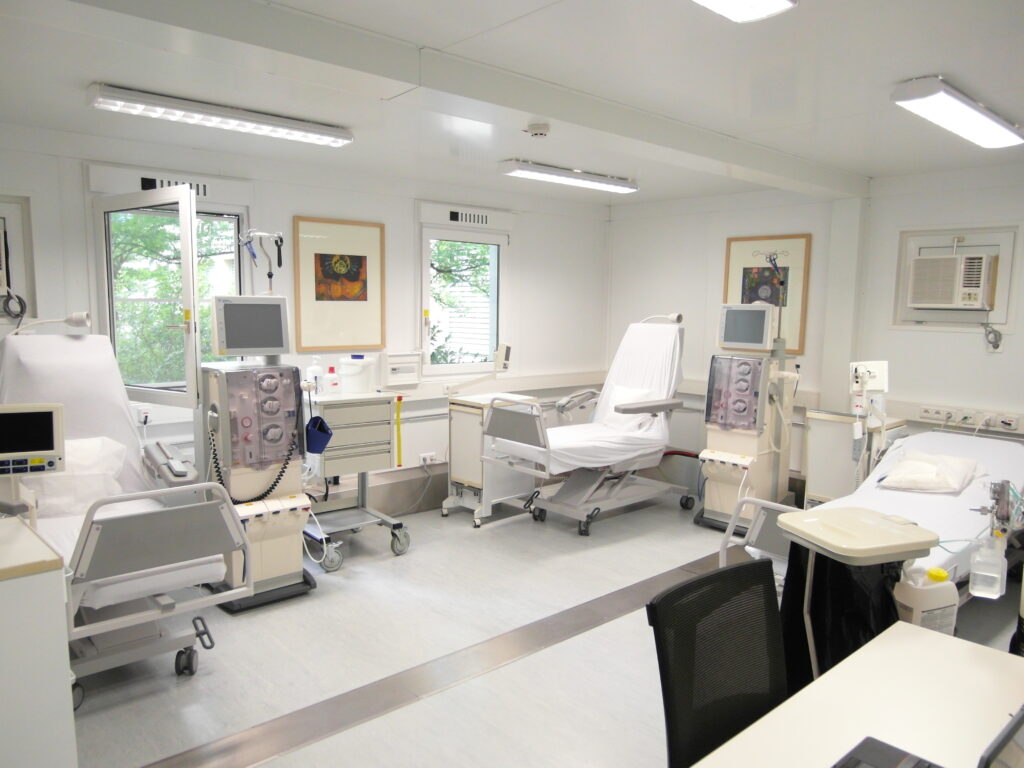
Healthcare environments must meet Health Technical Memorandum (HTM) and Health Bulletin Notices (HBN) standards relating to safety, infection control and clinical flow. Each Maxi Space modular building is designed to meet the required healthcare standards, helping temporary and permanent facilities maintain safety, compliance, and high-quality care as clinical practices evolve.
A Wide Range of Clinical Applications
Modular solutions support a wide range of healthcare functions, including wards, operating theatres, imaging suites, urgent treatment centres, and administrative workspaces. These adaptable buildings make it easier for healthcare providers to quickly and reliably create the spaces they need, ensuring clinical services can continue without unnecessary disruption.
Minimal Disruption to Live Hospital Sites
As modular buildings are manufactured off-site and assembled quickly once delivered, healthcare providers experience far less noise, traffic, and operational disturbance compared to traditional builds. This approach helps hospitals remain fully functional throughout the construction process, ensuring patient care continues uninterrupted while new facilities are added or existing spaces are upgraded.